A Fragile Democracy
How social workers can help make an impact in the 2026 midterm elections
By Sue Coyle, MSW
In many ways, it may feel as though the 2026 midterm elections began within hours of the conclusion of the 2024 presidential election, and certainly before Donald J. Trump was inaugurated as the 47th president. Concerns about whether there will be midterm elections in November, whether they will be free and fair, and whether the results will be confirmed have circulated through the media and online for more than a year. Every special election since January 2025, as well as the off-year elections, has been highlighted as either a bright light or a warning for what may come next. The same is true for the actions of the Trump administration and the responses from state and local governments.
As a result, and with midterms only a few months away, it would not be surprising if some felt exhausted by the idea of them or had already determined that what could be done has been done to ensure that the elections, voting rights and democracy are as safe as possible.
However, the midterms are not over until polls close on Nov. 3. There is still time for social workers and social work organizations to have an impact, to advocate for a fair election, and to hold up the candidates and officials who will use their voices and positions for the good of the people.
Precedence and Trends
To be effectively impactful, social workers must first understand what the midterms entail and what is at stake. Nationally, all 435 seats in the House of Representatives will be on the ballot in November, along with 35 Senate seats. Historically, the party not in power—in this case, the Democrats—regains ground if not some control through the midterm elections. In Trump’s first term as president, Democrats did not regain control of the Senate in 2018 but did do so in the House, gaining 40 seats. During the next round of midterm elections in 2022 under President Joe Biden, Republicans won the House, albeit narrowly, and Democrats maintained their majority in the Senate.
It would seem likely then that the 2026 elections will see a number of Democratic candidates winning, though it is not guaranteed they will regain control of either the House or the Senate. Current predictions forecast Democrats gaining significantly in the House, and while it was initially believed Republicans would maintain control of the Senate, that stance is wavering as polling highlights a growing dissatisfaction among Republican voters—not just Democrats and Independents—with Trump, the economy and more. The president may not be on the ballot, but his favorability or lack thereof likely will impact the Republican candidates who are up for election.
The hope that Democrats will have a successful election night is further bolstered by the recent outcomes of special elections throughout the country. For example, the Brookings Institution reported in April: “To date, 12 state legislative seats have flipped from Republican to Democratic control in special elections. When accounting for Democratic gains in the 2025 off-year elections in Virginia and New Jersey, the total number of flips from Republican to Democratic is 30. By contrast, no seats have flipped in the opposite direction. Democrats have overperformed by 4.5 percentage points on average.”
Threats to Voters’ Right & Fair Elections
Historic trends, recent elections, and polls do not tell the whole story, however. On the simplest level, too much confidence that a blue wave of votes will appear on Nov. 3 could lead to lower voter turnout and different-than-anticipated outcomes. Similarly, though on the opposite end of the spectrum, dread and apathy could lead to low voter turnout, shifting the results from what’s predicted.
“Previous elections dating back to 2016 and every midterm in between has been a toss-up. Especially now in the eyes of mid-decade redistricting, the number of competitive seats has dwindled drastically across the states and there continues to be this back and forth between the Democratic Party and the Republican Party,” explains Jeremy Haines, MA, director of public policy and government relations for NASW. “Both parties feel like they need to fight to maintain the majority. The problem if you don’t go out and vote is there aren’t voters and those safe seats or those competitive seats are chosen by a few votes instead of it being the will of the people.”
What’s more, the Trump administration and its closest allies appear to be doing everything they can to hamper the midterm elections and limit the rights and ability of individuals, particularly people of color, to vote.The president has, for example, threatened to or, according to his press team, joked about canceling the midterm elections altogether. The president does not have the power to do this, but he can attempt to make voting more challenging. A key example of this is The SAVE (Safeguard American Voter Eligibility) Act, which the president pressured Congress to pass. The U.S. Vote Foundation said the SAVE Act “would require voters to provide proof of citizenship when registering to vote, to show photo ID when casting a ballot, and to provide a copy of their identification when requesting and casting an absentee ballot.”
Such requirements would prevent millions of voting-eligible citizens from actually voting. It is estimated, in fact, that more than 21 million American citizens who are legally able to vote do not have access to a passport or birth certificate for proof of citizenship. It is important to note that the SAVE Act did not pass and is not likely to do so. However, the intent behind this bill illustrates the administration’s willingness to attempt to restrict voting.
Further impeding and/or confusing individuals’ rights and ability to vote is redistricting.Texas, Missouri and North Carolina have redrawn their maps to favor a Republican majority. Additionally, in April, the Supreme Court struck down Louisiana’s map, which included two majority-Black districts. This ruling led to the suspension of the state’s primary elections and will likely result in less minority representation in Louisiana and, down the road, in other states.
Consistently Democrat-led states have answered in kind with their own redistricting, specifically California and Virginia. However, the Supreme Court of Virginia struck down Virginia’s map in May, and the national Supreme Court rejected Virginia’s bid to restore it. Additional rumors and threats about the midterm elections have circulated throughout the news and social media, as well. While many if not most are neither true nor feasible, the chatter itself carries weight and may prevent some from participating in the election.
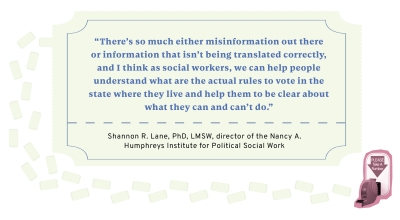
“There has been so much media about things like the SAVE Act and about ICE (Immigration and Customs Enforcement) being at polling places. The SAVE Act did not pass, and yet a lot of people assume that it did because it got so much press,” says Shannon R. Lane, PhD, LMSW, director of the Nancy A. Humphreys Institute for Political Social Work and Professor in Residence at the University of Connecticut School of Social Work. “There’s so much either misinformation out there or information that isn’t being translated correctly, and I think as social workers, we can help people understand what are the actual rules to vote in the state where they live and help them to be clear about what they can and can’t do.”
The Impact
The impact of the midterm elections depends on the outcomes, as well as to what degree fair and free voting is hindered. If the midterms are fair and free, a successful night for the Republicans would still have a negative impact on human rights, public assistance programs and future voting, as the Republican-led House and Senate would feel more free to push through legislation that aligns with the MAGA platform and Trump.
If in the lead up to the midterms voting rights are further restricted and redistricting disenfranchises key populations, the impact will not only be evident in future legislation, but also in how the country views voting integrity and the trustworthiness of the government; in who is able to vote moving forward; and potentially in the stability of U.S.democracy.
“Is democracy at risk?” posits Will Francis, LMSW, executive director of NASW’s Oklahoma, Texas and Louisiana chapters, when asked what’s at stake in the midterms. “I don’t know if democracy is at risk. What I think is access to democracy is at risk. I think that is, for me, a small reframe on it. They are essentially trying to say that unless you have certain documentation, unless you have this sort of access in a way that is based on historical access, the patriarchy, socioeconomic status, access in any way, you’re considered suspect. That’s really what worries me.”
Adds Lane, “I do think this is an important election, but I also was just reflecting on the fact that I feel like every two years of the last decade, people have been telling us this is the most important election of our lives, and I believe in democracy. I believe that every election is important, and I do actually believe some changes can happen depending on this election.”
Taking Action
As with every election, social workers must be active participants in the lead-up to November, working to protect the rights of all voters and their votes. What does that mean?
For starters, says Francis, social workers should be having conversations with their clients about voting—not about the candidates or how someone will vote but whether they will vote. “A lot of people are less inclined to engage in a simple conversation around are you registered, do you have a plan around voting, do you know what’s going on? And that used to really be much more the foundation of social work,” he says. “We’re really encouraging people not only to have and engage on their own level but to do that with clients. It’s non-partisan. It is not anything illegal. It is simply asking them about the process of getting involved in the election.” Make sure they know not only where to vote but what their options are if they don’t feel safe doing so in person on election day, says Lane. Many states offer mail-in and early voting. Outside of talking with clients, social workers can take action by getting informed.“My first suggestion for anyone who really wants to learn about elections and learn about candidates is go to their campaign websites. That’s going to be your primary source,” says Haines. He also recommends attending local events, particularly for local and state candidates.
And don’t “sleep on state and local elections,” Lane stresses. “In this time period, where there’s so much confusion at the federal level and it’s so challenging to get anything done in Congress, it’s really the state legislatures where things are happening.”Haines agrees, adding “Federal legislation is more like writing a novel. State legislation is like writing a letter. It takes a lot less time to pass and enact state legislation.”
Once informed, social workers can volunteer for campaigns or with issue-aligned organizations. They can volunteer at the polls, attend rallies, make phone calls or even just donate.What’s important is being involved. “We all know when it comes to global warming,” says Francis, “… unless the big companies (change), my small throwing of something in the recycling doesn’t change the larger picture. But if everybody throws something in the recycling, it moves the needle a little bit. That’s what I want people to think about when it comes to democracy. Don’t just do nothing.”
Above all, vote. “I wouldn’t be able to sleep at night if I didn’t vote,” says Joyce Dortch, MSW, a retired social worker and one of the first trustees of NASW’s PACE. “You have to take a part if you want to have a voice. You have to take a part, as small as it is, in political action.”
Sue Coyle, MSW, is a freelance writer and social worker in the Philadelphia suburbs.