America at 250: Social Work Legacy, Leadership and the Path Forward
By Maren Dale
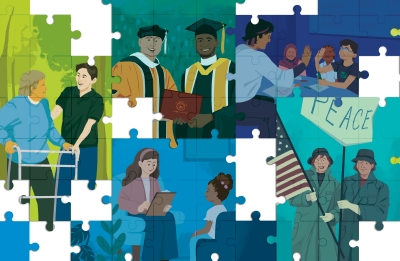
On July 4, 2026, the United States marked its 250th anniversary—a milestone that invites both celebration and reflection on our nation’s history of struggle and progress. Two hundred and fifty years ago, the Declaration of Independence articulated a vision of equality, dignity and opportunity that has shaped America ever since, even as our nation often has fallen short of those aspirations.
Although the social work profession would not be formally established until 1898, generations of individuals guided by the values that would later define the profession have helped communities move closer to those ideals through advocacy, service and a commitment to social justice.
This historic milestone offers a chance for personal reflection, but also an opportunity to examine our collective, evolving role in American life. It can be a time to think intentionally about where we stand today and how we choose to move forward as a unified force helping to shape the future.
At this time, it’s also important to recognize that although major strides have been made, the core challenges America faces today have not changed significantly in these many years. Certain groups are still marginalized. Children are still vulnerable. Inequities persist. But at the same time, the resources and insights that have been built—many with the help of social workers—enable us to face these challenges as they continue to evolve. When we do take steps back, new pathways often reveal themselves and allow us to take steps forward as well.
Social Work’s Legacy
There are many social workers throughout history who have helped shape U.S society in positive ways. They were instrumental in creating social safety net programs, like Social Security, Medicare and Medicaid; they fought for civil rights, human rights and systemic equality; they helped protect children through the establishment of child labor laws; and they brought mental health treatment to the forefront, helping to change the conversation and working to end the societal stigma around mental health issues. These are just a few examples of how social workers have contributed to the betterment of society over the past 128 years. You can learn more at NASW’s Social Work History page.
In very recent years we have witnessed the fragility of established laws and precedents. We have been forced to confront a sobering reality: Rights we once thought rock solid can indeed change, and we cannot assume hard-won victories will last forever by their own momentum. There is often great value in looking to the past and using it to help inform the future. When it comes to social work, many of the rights and protections we benefit from today exist because early social workers fought to embed them into federal programs. These pioneers saw the big picture, took a stand and could articulate their beliefs in a way that others understood and rallied around.
Homer Folks (1867-1963)

One social work pioneer who made a lasting impact was Homer Folks. From the 1890s through the mid-20th century, Folks helped define what social workers now recognize as the foundation of social determinants of health (SDOH). At a time when medicine often treated disease in isolation, Folks argued that poverty, housing conditions, child welfare, labor exploitation and access to care were inseparable from health outcomes. He pushed for systems change, advocating for foster care reform, mental health aftercare, child labor protections and tuberculosis prevention. He understood that effective social work required looking beyond the immediate symptom to the conditions shaping a person’s life.
“For today’s social workers, Folks’ legacy is a reminder that the profession has always been much more than case management alone. He employed all of the tools we teach in schools of social work today—the skillful collection and use of data, public advocacy, and community organizing to address inequities that threatened entire communities,” says former NASW President Kathryn Conley Wehrmann, PhD, LCSW, associate professor emerita at Illinois State University and chair of NASW’s Social Work Pioneer® steering committee.
Folks’ work also reinforced a principle that remains deeply relevant today: environment matters. When a social worker recognizes that a client’s anxiety is connected to housing instability, or that chronic illness is worsened by food insecurity and unsafe living conditions, they are continuing the work Folks championed more than a century ago. His career stands as an example of how social workers can influence not only individual lives, but also public health systems, legislation, and the broader social conditions that shape well-being.
Frances Perkins (1880-1965)
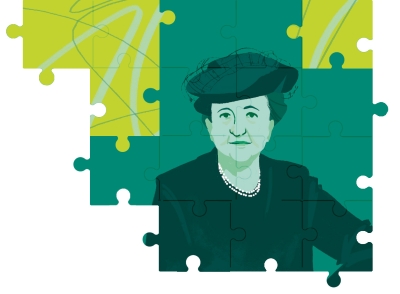
Frances Perkins, a social worker active from the early 1900s through the 1940s, remains one of the clearest examples of how a social worker’s understanding of human suffering, systems and inequity can shape national policy and transform millions of lives.
Perkins emerged from the settlement-house movement, which was established in the U.S. in 1889 by Jane Addams (known as the “Mother of Social Work”) and her friend, social reformer Ellen Gates Starr. Perkins was profoundly shaped by witnessing the 1911 Triangle Shirtwaist Factory fire, where garment workers—many of them young immigrant women—were trapped inside and died. Perkins believed both poverty and suffering often were the result of systemic failure.
Like Wehrmann, Bob Connolly, MSW, is a member of NASW’s Pioneer steering committee. He says Perkins is clearly the strongest social work role model, leader and expert in history.
“As the first female Cabinet member after her appointment as Secretary of Labor by (President) Franklin Delano Roosevelt, she demonstrated the essential social work skills of listening, assessment, systems change, advocacy, honesty, analysis, understanding economic and social factors, partnering, networking, interdisciplinary team skills, trust, and competence,” he says.
As U.S. Secretary of Labor, from 1933 to 1945, Perkins used both political strategy and her deep understanding of human vulnerability to help design and advance the Social Security Act of 1935. Perkins chaired the Committee on Economic Security, brought together economists, labor leaders, and policy experts, and worked persistently behind the scenes to build support for unemployment insurance, old-age benefits and worker protections during the Great Depression. She viewed economic security not as charity, but as a safeguard for human dignity—a belief that helped shape one of the most enduring pillars of the American social safety net.
Perkins’ legacy also raises an urgent question for today: What happens to systems like Social Security if social workers stop defending them? The pressures facing the program are no longer theoretical. The U.S. population over age 65 has surged in recent decades, while birth rates and the worker-to-beneficiary ratio continue to decline. Economic pressures—including student debt, childcare costs, housing instability and wage stagnation—are impacting young peoples’ decisions to become parents and are reshaping the up-and-coming workforce that must fund these programs.
At a time when conversations about retirement security, disability benefits and social security are intensifying, Perkins’ work stands as both a warning and a challenge to social workers and others: Systems built to protect human dignity survive only if people continue to fight for them.
Ruth Knee (1920-2008)

The 1960s and 1970s brought dramatic social, political and economic change to the U.S, and with those shifts came deeper questions for the social work profession. The conversation was no longer focused only on whether people received assistance of some kind, but on the quality of that assistance. For social workers, this era reinforced the essential truth that advocacy does not end once services are provided. It also includes protecting autonomy, amplifying individual voices and helping shape systems that honor the full human experience—especially during illness, aging and death.
One social worker who embodied that mission was Ruth Knee. Knee dedicated her career to advancing patient rights and helping establish hospice and palliative care as matters of dignity and public health—not optional comforts. Working alongside other advocates, she helped secure the Medicare hospice benefit in the early 1980s, fundamentally changing end-of-life care in the U.S. Hospice shifted dying away from an experience often marked by unmanaged suffering or impersonal institutional care toward one centered on comfort, support and quality of life.
For today’s social workers, Knee’s legacy is a reminder that some of the profession’s most important work happens at the intersection of policy and humanity. Social workers often are the professionals closest to patients’ fears and realities, and that perspective is essential not only in direct practice but in shaping the laws, systems and standards that protect individual dignity itself.
Dorothy Height (1912-2010)
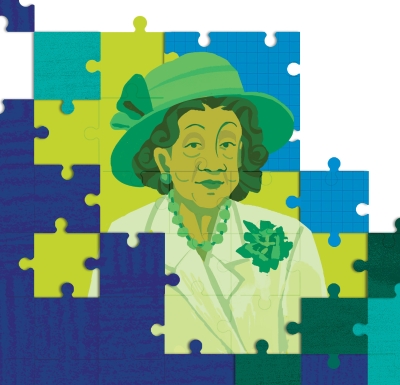
Social worker Dorothy Height was not only a civil rights leader—and one of the main organizers of the 1963 March on Washington for Jobs and Freedom—but she also was a leader for women’s rights. “Height was the first civil rights leader to formally and actively view inequality for women and African Americans as an intersecting, cohesive issue, merging movements that had previously been kept separate.” (en.wikipedia.org/wiki/Dorothy_Height). Height was elected the fourth president of the National Council of Negro Women (NCNW) in 1957 and continued in that role for 40 years. She focused on the issues of Foundational Black American women, including unemployment, illiteracy and voter awareness. Under Height’s leadership, the NCNWsupported voter registration in the South and financially helped civil rights activists across the country.
Height, known for her civil rights activism and skills in organizing, regularly was consulted for advice on political issues. First lady Eleanor Roosevelt, President Dwight D. Eisenhower, and President Lyndon B. Johnson often sought her counsel. For her efforts during the Civil Rights Movement, Height was recognized with many awards, including the Citizens Medal Award in 1989 and the Congressional Gold Medal in 2004.
Honoring the Foundation, Activating the Future
When looking at the contributions of these pioneers and other trailblazers, social workers today may ask—how do we build on these foundations and move forward, as individual practitioners as well as collectively?
One arena that can both guide and inspire is within the U.S. Congress, where two social workers are currently serving.
Sylvia Garcia is the U.S. Representative for Texas’ 29th Congressional District. Prior to her legal and political career, she earned a degree in social work from Texas Woman’s University and worked as a social worker. Among the many initiatives she leads, she is working hard to increase the presence of social workers in community libraries to help better serve vulnerable populations.
Hillary Scholten is another social work leader who has served as the U.S. representative from Michigan’s 3rd congressional district since 2023. Like Garcia, she co-sponsored legislation to establish a grant program to improve the recruitment and retention of school social workers.
Garcia and Scholten are proving that social work skills, like negotiation, systems-thinking and empathy, are the essential qualifications for 21st-century leadership. They are occupying seats of power to ensure social work values are always at the table when important issues are being discussed.
Lean on Social Work Values
Another social work leader, Barbara Lee, MSW, is a former longtime U.S. congresswoman and the current mayor of Oakland, Calif.
Like the early social work pioneers, she knows firsthand what it means to stand firm in her values under extreme pressure. On Sept. 14, 2001, just three days after the 9/11 terrorist attacks on the U.S, Lee relied on her social work foundation to cast the sole dissenting vote in Congress against an open-ended authorization for war—a stance that faced intense backlash then but is celebrated today for its courage.
When asked where social workers might look for guidance in moving into the future, Lee suggests revisiting the NASW Code of Ethics. On a practical level, a reminder to review these guidelines is particularly timely, since updates were made in 2021 to include language that addresses both the complexities of the digital world and the vital importance of professional self-care.
“Those core values—service, dignity, justice—are exactly what our country needs right now,” Lee says. “Social workers have always been on the front lines of change, and this milestone is an opportunity to recommit to equity, to challenge systems that don’t serve everyone, and to help shape a future rooted in compassion and accountability. This is essential if we are to achieve a more perfect union with both liberty and justice for ‘all.’”
Lee also encourages social workers to lean directly into their specialized training and use it to analyze root causes and advocate for systemic equity.
“Social workers have always been at the heart of the movements that move this country forward. I’ve seen it firsthand. You see the gaps, understand the root causes, and work every day to build something better,” she says. “That work matters more than ever. Keep pushing, keep organizing, and keep believing in what’s possible. Change happens because people like you show up, speak out, and never give up on building a more just and equitable future.”
Lee emphasizes that the courage required to lead during moments of societal division does not mean operating without fear, but rather operating with clear conviction.
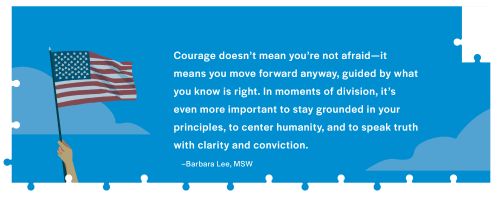
“Social workers are trained to stand firm in their values, even when it’s not easy. I am now often celebrated for my historic post-9/11 vote against war,” Lee says. “However, at the time, it wasn’t the popular opinion. Courage doesn’t mean you’re not afraid—it means you move forward anyway, guided by what you know is right. In moments of division, it’s even more important to stay grounded in your principles, to center humanity, and to speak truth with clarity and conviction. Change has never come from the majority alone. It comes from people willing to lead, even when they stand apart in some of the toughest moments.”
The Digital Future
Technology continues to have a profound and ever-growing impact on every one of us. It has also extended the social work profession’s reach into areas that early social work pioneers could not have imagined. Consider TikTok and Instagram as examples. Many social workers have embraced these platforms, democratizing mental health advice and advocating for social justice in real time. Some have millions of followers online.
This massive digital influence can and is making social work more visible and accessible than ever before. Then there’s artificial intelligence (AI). Just a few short years ago, who except those closest to it could have known what it is capable of and how rapidly it would be consumed by all sectors of society? It’s important to note that AI is now in its infancy. We’ve been told its full impact is unknown, but expect it to be unlike anything we have ever experienced.
Wehrmann has been working to help ensure social work enters into the dialogue around the ethics and use of AI. “Social work’s involvement with AI cannot be purely defensive—flagging the harms, and then stepping back. It must be assertive and sustained. It means educating ourselves about the power and potential of AI, occupying seats at the tables where AI systems are actually being designed, evaluated and regulated,” she says. “It means bringing our ethical framework into those rooms before the tools are built, not arriving afterward to critique what was built without us. Social work has always been called to stand with vulnerable populations at the point where power is exercised. In this moment, that point is the development of artificial intelligence—we need to step up.”
Looking Ahead With Intention
As we look back on 250 years of history and look forward to a frontier dominated by artificial intelligence and an aging population, we have to ask ourselves: Now what? Before we can answer, we have to recognize we cannot pour from an empty cup. If social workers fail to sustain themselves, they can’t move forward. But failing to answer the question of what is next as a unified professional body risks a future of systemic gridlock, where massive societal shifts outpace the profession’s fragmented efforts.
When social workers unite, they possess the power to turn these pressures into profound opportunities. Just as the early social work pioneers anchored the social safety net, today’s social workers are both caretakers and architects of the systems that make a just society possible.
Guided by the NASW Code of Ethics and the courage of those who came before, the mission remains clear: Social workers must ensure the foundation the pioneers laid remains steadfast; be forward-thinking; lead with conviction; and amplify the power of individual voices by coming together to collectively shape and evolve the profession—and the nation.
Maren Dale is a writer based in Washington State and has written for NASW since 2009. She has interviewed more than 500 leaders and written for more than 100 organizations in 18 states.