Social Worker of the Year Recognized for Going Above and Beyond for Students
By Laetitia Clayton
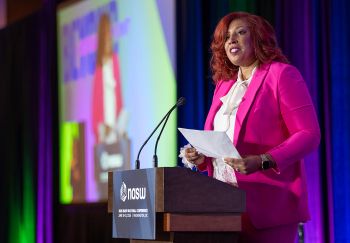 Dana Harley, NASW’s 2026 Social Worker of the Year, gives her acceptance speech during the NASW national conference in June.
Like many social workers, Dana Harley entered the profession based on a desire to help people and to pay forward the support she had received along the way to achieving her goals.
Harley, PhD, MSW, LISW-S, is NASW’s 2026 Social Worker of the Year. She is recognized not only for being a multiple award-winning educator and researcher, but also for the positive impact she has had on the lives of her students—both professionally and personally.
Harley’s own education journey started in nursing, but she soon realized that path wasn’t for her. “I went through my second round of clinicals and I kind of realized that I love working with people, had a great bedside manner, but changing wounds and things like that kind of wasn’t my thing,” she said. “So I wanted to find something that I could do that was still working with people and supporting people–just not nursing. And so I changed my major from nursing to mental health rehabilitation.”
Harley transferred to Wilberforce University (Ohio) to pursue her new major, and went on to earn an MSW from the University of Cincinnati and a PhD in Social Work from The Ohio State University in Columbus. Today, she is a professor and MSW program director at UC’s School of Social Work, where she educates and mentors the next generation of social workers both academically and personally.
“A lot of students that I mentor … they’re coming from disadvantaged backgrounds. And, you know, it’s not enough sometimes just to get them into the program,” Harley says. “They may not have transportation to get from their home to the university or they may have challenges around housing. So much of my mentoring has just gone beyond the academic piece, like (being) a supportive emotional mentor also for whatever social, cultural, emotional needs” students may have. “I think that’s something that I’ve really tried to tap into.”
Harley says she credits her own mentors for supporting her in this way, and wanted to give back.
“My grandparents, who raised me, they both passed away when I was an undergrad as a junior at Wilberforce. I was also without housing during this time,” Harley said. “And the faculty, my professors, they were very supportive. They helped me find internships in the summer, for example, that provided a stipend and housing. And so I knew from that moment that I wanted to make sure I had a career that supported people, because (my mentors) were so instrumental in shaping me and supporting me to go on to graduate school. And I finished there at the University of Cincinnati to pursue my Master of Social Work degree.”
One way Harley gives back is by helping her students secure grants and other funding. She has been the principal investigator or co-investigator on more than $12 million in federal, state and local grant awards. About $10 million of this funding has supported MSW students with scholarships, stipends and training to expand the behavioral health workforce.
“These grants ranged between $10,000 and over $30,000 for students who were in their field placements, and to support them through the program so that they could take on less educational debt,” she said. “Being able to secure fellowship funding through various federal programs and state programs to support behavioral health graduate students in social work—I think that has been one of the most impactful ways to support a variety of students who may have had food insecurity or housing problems or being unhoused, (or) if they needed transportation to and from their internship. So I think that has been most impactful. And just being able to write grants and get funded, and then offer those students that type of support so that they can focus on their studies.”
Photovoice Research
In addition to being recognized as an exceptional educator and mentor, Harley also has received awards for her research and scholarly works. As a community-based researcher, Harley specializes in Photovoice methodology, which she says she discovered during her doctoral journey when she was looking for ways to engage young people.
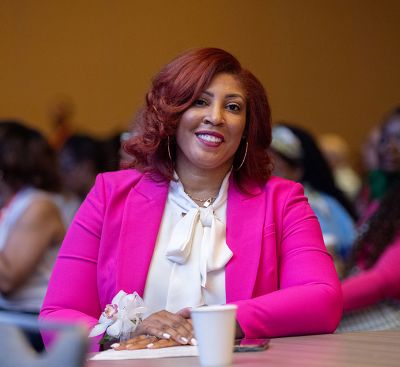 Dana Harley poses for a photo during the NASW national conference.
“My area of expertise is child and adolescent behavioral health. And as I was approaching my dissertation proposal, I was looking for methodologies that were culturally informed and also friendly for youth. So, you know, I didn’t want a traditional survey,” she said. “That’s how I came across Photovoice.”
Photovoice is a community-based participatory action methodology that gives participants a chance to express their thoughts, feelings and perspectives, or perceptions, through photography, Harley says.
“For example, I wanted to know how Black youth living in impoverished neighborhoods experienced hope. So I gave the youth cameras. I asked them to take pictures of what hope meant to them. And so that was my first research study using Photovoice,” she said. “Since then, I’ve used Photovoice with women who are unhoused. I’ve used it with the youth in schools, looking at barriers to graduation from high school. I’ve used it a lot of different ways since then.”
Harley says once the photos are taken and gathered, there is typically a gallery showing to display the photos and invite the community stakeholders to come view them.
“The wonderful thing about Photovoice is that it brings light to the participants’ understanding of the problem from their point of view,” she said. “So we’re not doing research on them, right? We’re co-constructing research. They’re telling us what the problem is. And the other wonderful piece about Photovoice is that it has some policy built into it in that the participants then give us ideas about how to resolve the issue. So we don’t just go into a community and say, ‘This is the best way to resolve this problem for this community.’ The community tells us here’s how we think we can resolve the problem.”
The Power of Hope
Harley also has done extensive research on hope, where she discovered that hope touched every aspect of the lives of the young people she engaged with.
“In the research literature, hope has been mostly viewed as just a cognitive process, something you think about. But I know based on my research that hope is something you can see, feel, you can hear. It’s very tangible,” Harley said. “So we find hope in ourselves. We find hope in other people. We find hope in our spirituality. We find hope in having our basic needs met. And so there are so many ways that we can tap into hope. And I think in general, when we think about mental health and wellness, I think hope is an anchor … so that when times get tough—and they will, over and over—we have something to help push us through.”
Even though Harley has received many awards during her career, she said being named NASW’s Social Worker of the Year is still something she’s trying to wrap her head around.
“I just would love to thank NASW again for selecting me as Social Worker of the Year,” she said. “It’s still sinking in. I haven’t quite gotten a hold of that in my mind, but thank you all for the work that you do.”
You can read more about Harley and her work, and also learn about the other 2026 national award recipients, who were honored during NASW’s national conference in June.