Social Workers Weigh Legal and Ethical Considerations of Psychedelic-Assisted Therapy
By Paul R. Pace
Interest in the use of psychedelics for mental health treatment is growing among social workers and other mental health professionals, who wonder if such treatment is legal or even ethical.
“This is really in the gray zone still,” explains Jeffrey Zabinski, MD, MSW, director of Interventional Psychiatry at Columbia University Irving Medical Center and an associate program director in the adult psychiatry residency. “We’re not quite to a place where the FDA has approved any psychedelics for treatment of any mental health conditions.”
Despite this, “a lot of behavioral health professionals are labeling themselves as psychedelic-assisted psychotherapists,” says Brenden Hargett, PhD, LCMHC, LCAS, NCC, MAC, vice president of operations and director of ethics at the National Board for Certified Counselors.
“We’re not medical professionals, so if we use that label—psychedelic-assisted psychotherapists—what does that mean in the context of what we do and how we do that?” Hargett says. “I think that, certainly, the research is evolving. However, in terms of how it applies specifically to behavioral health professions and what we do and how we do that independent of a medical professional are some of the concerns.”
There are “underground spaces” where patients are receiving these treatments, he said, adding that many of the testimonials are coming from those programs. “You have clinicians who may have experience in the research settings who are doing this work outside of a sanctioned environment—and following those protocols, but at great personal risk,” Hargett says.
Zabinski and Hargett shared these comments as expert panelists for the NASW webinar “Ethics Table Talk: Ethical Considerations for the Use of Psychedelics in Mental Health Treatment.” It is available on demand at NASW’s Social Work Online CE Institute.
Is it legal?
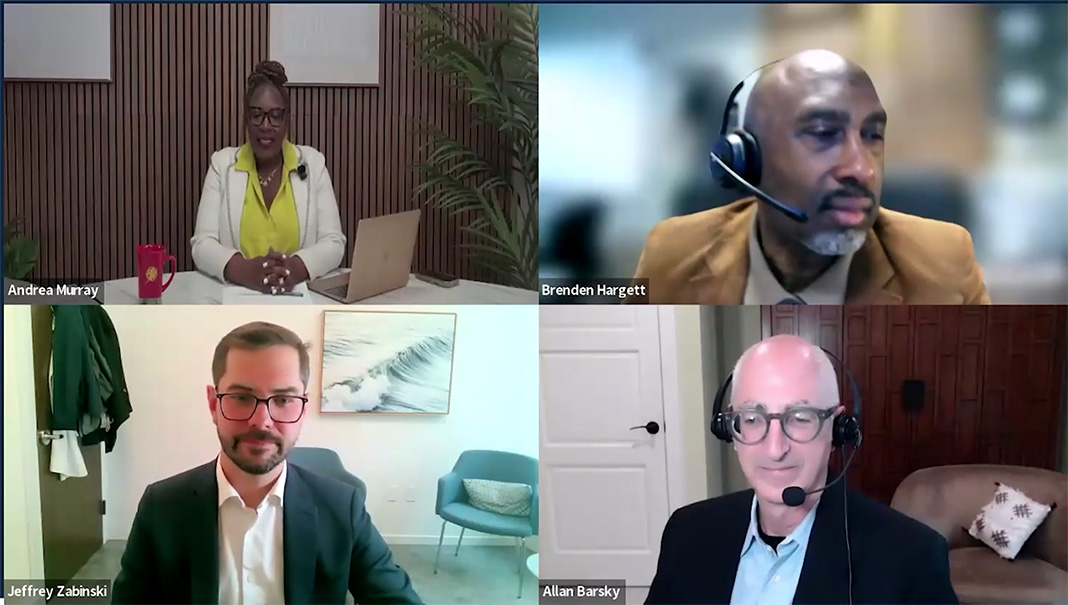
Panelists for the NASW webinar, “Ethics Table Talk: Ethical Considerations for the Use of Psychedelics in Mental Health Treatment,” discuss the challenges associated in using psychedelics in mental health treatment.
Allan Barsky, PhD, MSW, JD, professor with Florida Atlantic University’s Sandler School of Social Work, also was a panelist for the webinar. He says most psychedelics and hallucinogens are classified as a Schedule 1 drug, which means there are no federal medically approved or research-approved purposes for these substances. It remains illegal to possess, purchase or cultivate these types of drugs under federal law.
“If we are aiding, abetting, (or) counseling people to use those substances, we may be criminally responsible,” Barsky says.
Across states, however, the laws may differ or be deemed a low priority to prosecute, but this still represents a risk, Barsky notes.
It’s important to look at not only criminal law enforcement of these substances but also how they could affect clinical licensure and the Code of Ethics, “which expects us to follow the laws,” he says.
Knowing this, Andrea Murray, MSW, LICSW, director of the NASW Office of Ethics and Professional Review, who served as the panel moderator, asked how mental health providers navigate the conflicts of the potential benefits of psychedelics and the lack of universal acceptance of this practice.
Zabinski said even if social workers cannot work with clients using these substances in a clinical setting, they can make sure they are ready and know as much as they can for a situation where these substances may be approved in the future. It’s important to make sure your practice is ready for such a change, he said.
“There is no accreditation body for psychedelic-assisted therapy,” Zabinski pointed out.
He noted the Columbia University School of Social Work offers the first degree within a psychedelic–assisted therapy training program. According to the school, it prepares graduating MSWs to enter the psychedelic-assisted therapy field with four courses, totaling 112 hours of classroom learning and 50-plus hours of asynchronous learning related to psychedelic-specific curriculum, and a relevant 600-hour practicum placement, at no additional cost to their MSW education.
There also is the concern of potential addiction to psychedelics.
Hargett said, ethically, looking through his addiction lens, it is important to know if the client has a history and family history of scheduled-substance use, and the risk of addiction to them.
“History (of the client) is very important to assess,” he said. “In alignment with that, we also have to look at (the person’s) mental health history.”
This webinar is part of NASW’s Ethics Table Talks series, which provides a safe space for discussing critical issues facing mental health professionals through the lens of ethics and other considerations. Learn more.