Unhoused U.S. Military Veterans Deserve Better Services
From the President
By Yvonne Chase, PHD, MSW, LCSW, ACSW
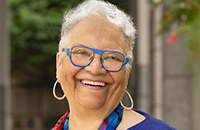
I want to talk to you about something I consider shameful for a country considered to be one of the wealthiest in the world: unhoused veterans. These are individuals who have served our country willingly, many in combat zones more than once. Some return to civilian life unprepared due to both physical and mental injuries, including traumatic brain injuries (TBI).
According to the National Coalition for Homeless Veterans (NCHV), on any given night there are more than half a million unhoused people in the United States. While the estimates for homeless veterans seem to be more difficult to determine with any accuracy, the NCHV estimates that veterans account for approximately 5% of the total number of adults experiencing homelessness at any given point. That may seem like a small number, but the estimate for the percentage of the general population experiencing homelessness is 7%.
The demographics on unhoused veterans provide data that should identify what services are most needed and in what areas of the country. When I look at the following statistics, I have to wonder why services are not targeted to better address the needs of this vulnerable population.
Homeless Veteran Demographics (NCHV)
- 5.3% of the homeless adult population are veterans
- 20% of the male homeless population are veterans
- 68% reside in principal cities
- 32% reside in suburban/rural areas
- 51% of individual homeless veterans have disabilities
- 50% have serious mental illness
- 70% have substance use problems
- 51% are white males, compared with 38% of non-veterans
- 50% are age 51 or older, compared with 19% of non-veterans
- The percent of homeless veterans is two to three times that of their counterparts who are housed.
A study by Tsai and Kelton, published in 2022, examined the service use and the barriers to care for unhoused veterans. The results, while not surprising, were indications of how the structure of the vast network of providers, including the VA, is not responsive to this population in need.
The barriers most cited by the participants in this study included: not knowing where to seek help; being embarrassed to ask for help; lack of adequate transportation; treatment costs; difficulty getting an appointment; and mistrust of mental health professionals.
In another study, Testa and Tsai (2023) explored the relationship between loneliness and firearm acquisition among low-income, unhoused veterans. Considering the risks both of these pose for suicide, the authors suggest the need for strategies to address and develop safe practices.
These are not problems to be solved by one discipline alone, but it is time for social work to take a leading role. We have used the communication skills and knowledge of navigating complex systems—that are the framework for the social work profession—to identify changes to policies and programs that could eliminate these barriers.
In an effort to bring a more focused approach to helping unhoused veterans and addressing other challenges for those who serve or have served our country, the NASW national board has approved my request to establish a committee on military/veteran issues.
I plan to have committee appointments completed by Jan. 1. If you are working in this specialty area and are interested in being part of this committee, I urge you to submit your CV or resume and a letter of interest to governance@socialworkers.org.
Contact Yvonne Chase at president@socialworkers.org.