Indigenous Studies: Drawing From Native Knowledge
Schools of Social Work
By Peter Craig

Despite concerted efforts in the U.S. over past centuries to eradicate or at least dramatically marginalize Native Americans (American Indians, Alaska Natives and Native Hawaiians), “we’re still here,” says Dr. Pamela Begay of the Diné Nation. And in recent decades, adds the associate professor of practice at the Brown School at Washington University in St. Louis, social work has seen new approaches to better serve Indigenous people’s needs, including recruiting more tribal students to the discipline.
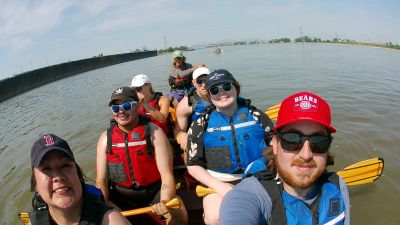 Community building at the Brown School: Kathryn M. Buder Center for American Indian Studies scholars Daryn Lowe (first row, left), Jonah
EagleFeather (second row, left) and Savannah Nieshe (second row, right) on a Mississippi River canoe trip in September that also included
professors and Native community members and partners.
Community building at the Brown School: Kathryn M. Buder Center for American Indian Studies scholars Daryn Lowe (first row, left), Jonah
EagleFeather (second row, left) and Savannah Nieshe (second row, right) on a Mississippi River canoe trip in September that also included
professors and Native community members and partners.
The Brown School, for example, has the Kathryn M. Buder Center for American Indian Studies, directed by Begay and offering scholarships through the Buder Foundation to enrolled tribal students, and learning and research opportunities to all students. Interested MSW students can become part of the “American Indian and Alaska Native” concentration and take the MSW’s core courses along with the four required Indigenous-specific courses.
One of this year’s Buder scholars is Savannah Caitlin Nieshe, an Alaska Native who took “Indigenous Mental Health” in 2024-25 and “Community Development With American Indians and Other Indigenous Tribes” last fall. She knew she wanted to pursue social work after working at the Community Connections support center in her hometown of Ketchikan at age 18.
Way Out West
The Social Work Department at the University of South Dakota, whose state is more than 10% Native American according to U.S. News and World Report, does not have a formal concentration or specialization in Indigenous studies for its advanced generalist MSW program, says lecturer Kathryn LaPlante, MSW, a member of Oklahoma’s Otoe-Missouria Tribe. But students can fashion their own related clinical track by taking “Social Work With American Indians” and completing internships at sites like the federal Indian Health Service, she adds.
LaPlante’s school also recruits tribal students. This year there are five in the MSW program, up from two in 2024-25.
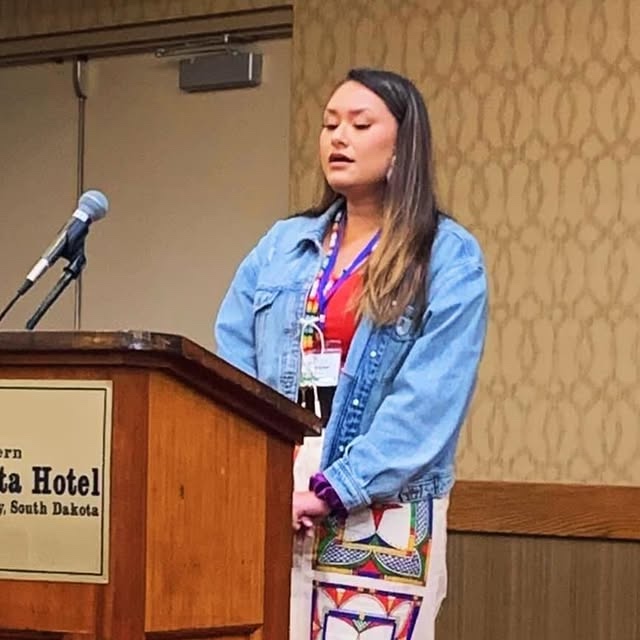 Lakota recording artist and social worker Tiana Spotted Thunder opens the 2024 NASW-South Dakota West River Symposium in Rapid City with a tribute song for an honoree. Regular attendees of the annual Indigenous-themed event include social work educators like the University of South Dakota’s Kathryn LaPlante, who praises the symposium for its role in “strengthening social work practice with Native populations by emphasizing cultural knowledge.”
Christopher Sharp, MSW, MPA, is a Mohave from the Colorado River Indian Tribes whose parents both became social workers. Sharp is now clinical assistant professor and director, Office of American Indian Projects, at Arizona State University’s (ASU) Watts College of Public Service and Community Solutions School of Social Work, where he helped establish the school’s own CSWE-like EPAS (Education Policy and Accreditation Standard).
Part of its mission is to lay out the traumatic history and the resilience of tribes in the Southwest, including those in the borderlands. There are specialty courses like “Indigenous Social Policy and Advocacy” for BSW students and “Social Work with Indigenous and Tribal Communities” for MSW students. Yet the school also wants to make sure this history is imbued in every course.
To help in this, it now employs five Indigenous professors and counting.
Indigenous Needs
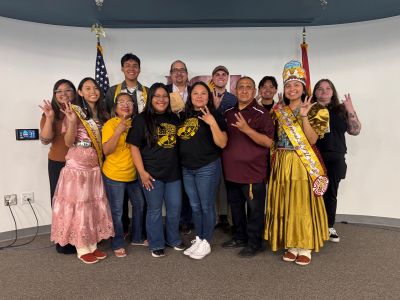 Celebrating the 30th anniversary of Arizona State University’s American Indian Social Work Student Association (AISWSA) last May: ASU clinical assistant professor Christopher Sharp (back row, wearing glasses) and MSW student Amber Means (front row, in white sneakers), with members of AISWSA and of the Ms./Mr. Indigenous ASU Committee.
What should social work students learn about American Indians and other Indigenous peoples? First would likely be an understanding of their historical mistreatment by the U.S. government and society as a whole—such as forced migration, placement on reservations, chronic treaty breaking and extraction of resources—that’s contributed to depression, drug and alcohol abuse, suicide and other problems.
Unfortunately, there’s still a lack of decent mental health care for Native Americans in her state and others, says Dr. Rebecca Maldonado Moore, a Northern Arapaho who is a professor at Facundo Valdez School of Social Work, New Mexico Highlands University. To become an effective direct practitioner, she adds, “you have to have a handle on the systemic challenges or barriers that make it difficult for Native people to survive.” Brown School MSW student Nieshe agrees that drawing on a more macro view and “knowledge of systems” will only improve her own future clinical practice.
Also important for students is gaining cultural competence and humility, as emphasized by NASW and CSWE. For example, many Native Americans don’t really grasp the one-on-one, “clinical” concept, says ASU professor Sharp. For them, it’s more about “healing within groups, healing within communities… celebrating your survival and your culture.” Call it “Indigenous ways of knowing.”
And although non-Native students will naturally have the most to learn about cultural competence and humility, even Native students need to appreciate the differences between Indigenous categories and the tribes within, say professors and students. “For instance, Navajos can’t be out during an eclipse; they have to be inside. It’s a time for prayer and meditation for them. Whereas other tribes don’t have that,” says ASU MSW student Amber Means, granddaughter of the late American Indian rights activist Russell Means, who helped lead the Wounded Knee occupation in 1973 and many other protests.
Means, who is Hopi and Oglala Lakota, adds that social work students “can really benefit and learn from tribal nations and our spiritual connection. They’ll also see how tribal people’s support for one another is very similar to social work. And sometimes I wonder if that’s where social workers got it.”
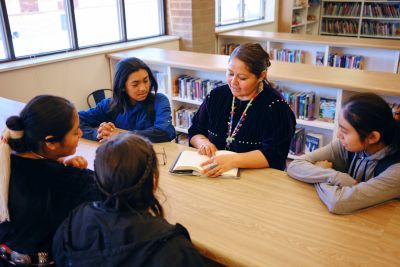
Drilling Down on Indigenous Social Work Education
From early on in Indigenous health study and research, there have been scholars who have completely immersed themselves in tribal culture and knowledge of healing, says Christopher Sharp, MSW, MPA, clinical assistant professor and director, Office of American Indian Projects, at Arizona State University’s School of Social Work.
One of them is Eduardo Duran, whose works include “Healing the Soul Wound: Trauma-Informed Counseling for Indigenous Communities.” “He just kind of reframes everything,” says Sharp, who assigns such readings to his MSW students. “It’s metaphorical, it’s storytelling… it’s understanding that diagnosis at times is problematic. It challenges a lot of the basis of clinical work and its Western focus. And I tell my clinical students that this is something that will change their thinking
about practice.”
Kathryn LaPlante, MSW, social work lecturer at the University of South Dakota, is currently getting her DSW from the University of Kentucky-Lexington. She’s focusing her capstone project on the need to evolve beyond the Western view of social work with Indigenous people. “Suddenly, it’s ‘Wait a minute, I’m not being informed through an Indigenous lens, and I’m supposed to be advocating for Indigenous people,’” she says. “But now that we have more Native American scholars and researchers—like Michael Yellowbird and Hilary Weaver—who we can draw from in training our social work students, everything I’m trying to do with the capstone will fall under the decolonization of social work practice.”
Published works on helping Indigenous populations include the following:
- “‘Being’ Native versus ‘Going Native’: Conducting Social Work Research as an Insider” (academic.oup.com/sw/article-abstract/45/5/439/1879788) by Valli Kalei Kanuha
- “Hearing Indigenous Voices in Mainstream Social Work” (journals.sagepub.com/doi/abs/10.1606/1044-3894.3592) by Mel Gray, John Coates and Tiani Hetherington
- “Indigenous People and the Social Work Profession: Defining Culturally Competent Services” (academic.oup.com/sw/article-abstract/44/3/217/1890160) by Hilary N. Weaver
- “Indigenous Youth Participatory Action Research: Re-visioning Social Justice for Social Work With Indigenous Youths” (academic.oup.com/sw/article-abstract/58/4/314/2962403) by Katie Johnston-Goodstar
- “Treatment Issues for Native Americans: An Overview of Individual, Family, and Group Strategies” (commons.und.edu/cgi/viewcontent.cgi?article=1071&context=ehb-fac) by Cindy L. Juntunen and Paula M. Morin
- “Tribal Sovereign Status: Conceptualizing Its Integration into the Social Work Curriculum” (ncwwi.org/index.php/resourcemenu/resource-library/inclusivity-racial-equity/advancing-racial-equity/1568-tribal-sovereign-status-conceptualizing-its-integration-into-the-social-work-curriculum/file) by Amy Fischer Williams