The Wound You Can’t Medicate: Why Social Workers Must Distinguish Moral Injury From PTSD
Viewpoints
By Rivka Edery, Psyd
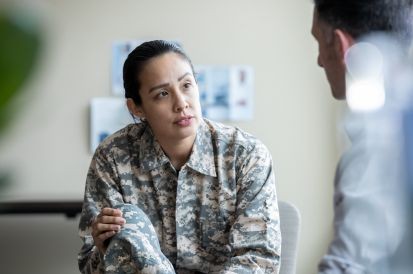
“David’’ (a composite client) sat in my office, staring at the floor. He was an infantry veteran with multiple combat deployments. He had been treated for post-traumatic stress disorder for years at various clinics— undergoing prolonged exposure therapy, cognitive processing therapy, and a litany of medications. “I’m not scared of the fireworks, doc,’’ he said quietly. “I know I’m safe here. That’s the problem. I’m safe, and he isn’t. And it’s my fault.’’
David didn’t have a fear problem. He had a conscience problem.
As clinical social workers, we have been trained extensively to identify and treat PTSD. We watch for hypervigilance, flashbacks and avoidance. We treat the nervous system because we know trauma keeps the body in “survival mode.” But while treating military populations, I often find veterans like David whose deepest wound is not physical fear, but a fundamental betrayal of their sense of right and wrong. This is moral injury, and if we treat it like regular PTSD, we risk failing ourselves and the patients we serve.
The Soul Wound vs. The Safety Wound
PTSD corrupts the body’s safety mechanism—the body’s alarm system is stuck “on.” Moral injury, in contrast, is a corruption of the trust mechanisms of the soul. It occurs when an individual does not acknowledge or stop behavior that violates their deeply held morals and norms. PTSD and moral injury can frequently co-occur, but they demand distinct clinical discernment. Here are three differences that every social worker, both civilian and military, needs to learn to recognize.
The Shift from “I Was Scared” to “I Am Bad.”
The indicator of moral injury is the presence of crushing toxic shame, not necessarily fear. On an intake for PTSD, a client often describes a threat to life: “I thought I was going to die.” The predominant effect is terror. When a clinician tries to use standard fear-extinction models on a morally injured veteran—asking that participant to describe the trauma to desensitize the fear response—it can have the opposite effect. You cannot “desensitize” a person who believes they have sinned. In fact, without the proper framework, reliving the incident can exacerbate the shame spiral.
The Betrayal Barrier.
Moral injury frequently arises from “Betrayal Blindness,” which is betrayal by a breakdown in trust in leadership or systems. For example, a soldier who abides by orders resulting in civilian casualties, or who is assaulted by a superior, sees a discontinuity in their conception of justice. In therapy, this often shows up as overwhelming cynicism or fury toward institutions. Medically, this could be classified as a personality disorder or paranoia. Seen through a social work lens, this is what we observe: A rational reaction to a systemic failure. Veterans do not need to be told that their thinking is distorted; they need their sense of injustice confirmed.
Spiritual Anomie. Sociologist Émile Durkheim employed the term anomie to describe a state of instability caused by the collapse of standards and values. I witness this in military social work every day. Moral injury foments an existential crisis that no medication could address. Veterans may lose their faith—“Where was God?”—or embrace a nihilistic worldview—“Nothing matters.” This is not merely clinical depression; it is a spiritual crisis.
Why Social Work?
If psychiatry looks at biology and psychology looks at the mind, social work looks at the person-in-environment. Moral injury is an environmental wound, and is most effectively treated in social work. It is a breach in the bond between a person and their society, their community, their beliefs, their values, and their culture. Addressing this rupture goes beyond symptom treatment. It includes forgiveness work, reintegration into the community, and advocacy. This is the bedrock of our professional work.
The Call to Action
The challenge for the social work community is to pay attention to the shame. When a veteran walks into your clinic, community center, or shelter, do not assume it is just the trauma of fear. Ask about their values. Ask about their guilt. If we really desire to help those who have served, then we need to be prepared to dwell in the uncomfortable void of the wound we are dealing with—and help them return to their humanity.

Rivka Edery, PsyD, LCSW, is a psychotherapist specializing in military behavioral health in private practice. A current NASW member, she is passionate about bridging the gap between military culture and civilian clinical practice.
References / Suggested Reading
Koenig, H. G., et al. (2020). “Examining the Overlap Between Moral Injury and PTSD in US Veterans and Active Duty Military.” The Journal of Nervous and Mental Disease, 208(1), 7-12. (Provides clinical data differentiating the two conditions).
Williamson, V., Murphy, D., & Greenberg, N. (2020). “Occupational moral injury and mental health: systematic review and meta-analysis.” The British Journal of Psychiatry, 216(6), 309-315. (Establishes
the link between moral injury and broader mental health outcomes).
Williamson, V., et al. (2021). “Moral injury: the effect on mental health and implications for treatment.” The Lancet Psychiatry, 8(6), 453-455. (Argues for treatment models distinct from PTSD protocols).
Levi-Belz, Y., & Zerach, G. (2024). “The impact of moral injury on trajectories of depression: a five-year longitudinal study among recently discharged Israeli veterans.” Psychology & Health. (Recent longitudinal evidence on the long-term impact of moral injury).