Introduction
The NASW Legal Defense Fund (LDF) was established in 1972 by the NASW Board of Directors to
provide educational materials related to advocacy for social work issues, to educate members and
others about legal issues related to social work, and to assist NASW members and the social work
profession in lawsuits to protect legal and ethical principles important to the profession. LDF is
located within NASW’s Office of General Counsel (OGC) and staffed by the OGC.
Over the years, LDF has provided financial support to numerous members with legal cases and legal
support for “friend of the court” briefs (amicus curiae briefs). The funds for LDF case support and
educational projects have come primarily from the voluntary dues check-off (currently $10) by NASW
members on their initial and annual renewal applications.
LDF has underwritten educational projects for NASW members, including conferences, webinars, and
other courses. The funding for some of these projects is provided by the Aileen Neely Fund and the
Social Work Ethics and Law Institute (SWELI), which are designated charitable funds for LDF
education projects, housed within the NASW Foundation.
LDF Amicus Curiae Briefs
NASW, through LDF, is frequently asked to initiate the filing of a brief with a unique social work outlook
or to participate in
amicus curiae briefs initiated by other organizations with shared interests in a
particular policy area. NASW’s participation in these briefs is based on the principles in the NASW
Code of Ethics and NASW’s policy statements published in Social Work Speaks. The support of well
qualified
pro bono legal counsel is utilized in most cases to facilitate NASW’s participation as a friend
of the court. In 2025, six amicus briefs were filed on behalf of NASW and chapters, which include:
People of Michigan v. Cinecca Madison, 25 N.W.3d 122 (Mich. 2025)
(Michigan Supreme Court)
Case Description: In Michigan v. Madison, the Michigan Supreme Court is considering whether
defendants may introduce scientific evidence of mental illness to negate the specific intent required
for certain crimes. The amicus brief argues that longstanding precedent barring such evidence ignores
well-established scientific research showing that serious mental illness can impair a person’s ability
to form specific intent even when they are not legally insane. The case presents an opportunity for the
Court to reconsider that precedent and restore the diminished-capacity defense consistent with both
science and legislative intent.
NASW Supported: Madison
Outcome: Undecided
Date Brief Filed: March 12, 2025
Catholic Charities of Jackson v. Gretchen Whitmer, 162 F.4th 686 (6th Cir. 2025)
(U.S. Court of Appeals Sixth Circuit)
Case Description: This case challenges the constitutionality of Michigan’s ban on conversion therapy
for minors, which prohibits licensed counselors from engaging in gender identity and sexual
orientation change efforts. In an amicus brief, NASW and allied professional organizations argued that
sexual orientation and gender identity change efforts are discredited and not supported by credible
scientific evidence. Studies have shown that these practices are particularly harmful for minors. The
brief urged affirmance of the lower court’s decision to allow the conversion therapy ban to remain in
effect as the case is argued, emphasizing that the ban protects vulnerable youth from practices linked
to severe psychological distress and increased suicide risk.
On December 17, 2025, the Court of Appeals blocked Michigan’s ban on conversion therapy for
minors until a final decision is made by the lower District Court. In a 2-to-1 decision, they ruled that
Michigan’s law is likely unconstitutional because it limits speech based on its content, as genderaffirming
talk therapy is allowed while conversion talk therapy is not. Although the overall case
contesting Michigan’s conversion therapy ban is still ongoing, its constitutionality is set to be decided
by the Supreme Court in the case of
Chiles v. Salazar, No. 24-539 (U.S. argued Oct. 7, 2025).
NASW Supported: Whitmer
Outcome: Unfavorable
Date Brief Filed: June 3, 2025
Chiles v. Salazar, No. 24-539 (U.S. argued Oct. 7, 2025).
(U.S. Supreme Court)
Case Description: This case will determine if states can ban conversion therapy for minor clients, as
Chiles claims that Colorado’s ban on minor conversion therapy limits the First Amendment rights of
freedom of speech and freedom to exercise religion. In this amicus brief, NASW joined other
professional organizations in arguing that talk therapy is a mode of treatment and not speech, and
that the documented negative effects of conversion therapy require states to ban its use to protect
their citizens from undue harm. NASW urges the Supreme Court to affirm the rulings of the lower
courts, and to allow states to continue to protect LGBTQ+ children from harmful practices.
NASW Supported: Salazar
Outcome: Undecided
Date Brief Filed: August 26, 2025
Little v. Hecox, No. 24-38 (U.S. argued Jan. 13, 2026) & West Virginia v. B.P.J., No. 24-43
(U.S. argued Jan. 13, 2026).
(U.S. Supreme Court)
Case Description: NASW, the American Psychological Association, and the American Association for
Marriage and Family Therapy joined in this amicus brief to advocate against state laws in Idaho and
West Virginia that ban transgender women and girls from participating on sports teams consistent
with their gender identity. Barring transgender people from participating in sports stems from and
contributes to harmful stigmas that negatively impact their health and wellbeing. Participation in
sports nurtures teamwork and leadership skills, develops self-confidence, and fosters a sense of
belonging. This issue reflects NASW’s mission to advance social justice, protect human dignity, and
ensure equitable access to care.
NASW Supported: Hecox and B.P.J.
Outcome: Undecided
Date Brief Filed: November 25, 2025
Ethical Soc'y of Police v. Bondi, No. 1:25-cv-13115-IT (D. Mass. Oct. 30, 2025)
(U.S. District Court in Massachusetts)
Case Description: This case will determine if the United States Department of Justice can unilaterally
abolish the Community Relations Service (CRS), which has been an integral part of conflict resolution
and community support since its creation by the Civil Rights Act of 1964. The role of the CRS is to
actively facilitate discussions between communities and the government during times of tension,
such as in the aftermath of mass shootings and natural disasters. The CRS also assists in programs
that help heal communities from past traumas and works toward better relationships between
government agencies and the public. NASW supports the CRS and its foundation in social justice
principles and stands against the unlawful action of the Department of Justice.
NASW Supported: Ethical Society of Police
Outcome: Undecided
Date Brief Filed: December 5, 2025
Clemency Letters
Clemency letters aim to advocate for mercy or leniency in the sentencing of an individual based on
various humanitarian grounds, including rehabilitation prospects, remorse, and mitigating
circumstances such as a mental health diagnosis. For those facing the death penalty, LDF is
occasionally asked to argue for commutation of the sentence to life imprisonment without the
possibility of parole, rather than execution. In 2025 LDF wrote two clemency letters:
David Lee Roberts
NASW submitted a clemency letter on behalf of David Lee Roberts, who is currently on death row in
Alabama for first degree murder. Mr. Roberts’ poverty and history of severe mental illness were
instrumental in his crime, conviction, and years in solitary confinement. We believe in the practice of
social justice, dignity and worth of a person, and the importance of human relationships. Given Mr.
Roberts’ extensive history of mental illness and the circumstances of his death sentence, we asked
Governor Kay Ivey to commute Mr. Roberts’ sentence to life in prison without parole. Mr. Roberts’
execution remains on hold.
Lance Shockley
NASW submitted a clemency letter on behalf of Lance Shockley, who was on death row in Missouri
for Capital murder. NASW stands firmly against the use of the death penalty due to its finality, its
cruelty, and the grave risk of wrongful conviction. Given the lack of direct evidence in Mr. Shockley’s
case, his consistent claims of innocence, and the positive contributions he had made while
incarcerated, we urged Missouri Governor Mike Kehoe to commute his sentence to life in prison
without parole. Mr. Shockley was executed on October 14, 2025.
LDF Helpdesk Calls
When members are handed subpoenas, face murky mandated reporting situations, or need to
understand confidentiality rules for minor clients, they turn to the LDF Helpdesk for guidance. The LDF
Helpdesk provides members with direct access to timely, practical information and resources at the
intersection of law and social work.
Members frequently seek guidance on topics such as responding to subpoenas and records requests,
navigating confidentiality when working with children, and determining whether a situation triggers
mandated reporting obligations. Many of these issues are also addressed in LDF’s Legal Issue Articles,
which serve as an ongoing resource for members.
The LDF Helpdesk provides legal information—not legal advice—and members are encouraged to
consult an attorney licensed in their state for representation or matter-specific legal support.
Hours of Operation
The LDF Helpdesk is available Tuesdays and Thursdays from 9:30 AM to 12:00 PM ET and 2:00 PM to
4:30 PM ET. Please visit our
website to learn more.
2025 Impact
In calendar year 2025, the LDF Helpdesk responded to calls from 801 members and sent 323 followup
emails providing targeted resources and guidance. The Helpdesk averaged 67 calls per month, with
demand peaking at 101 calls in July.
2025 LDF Helpdesk Calls by Month
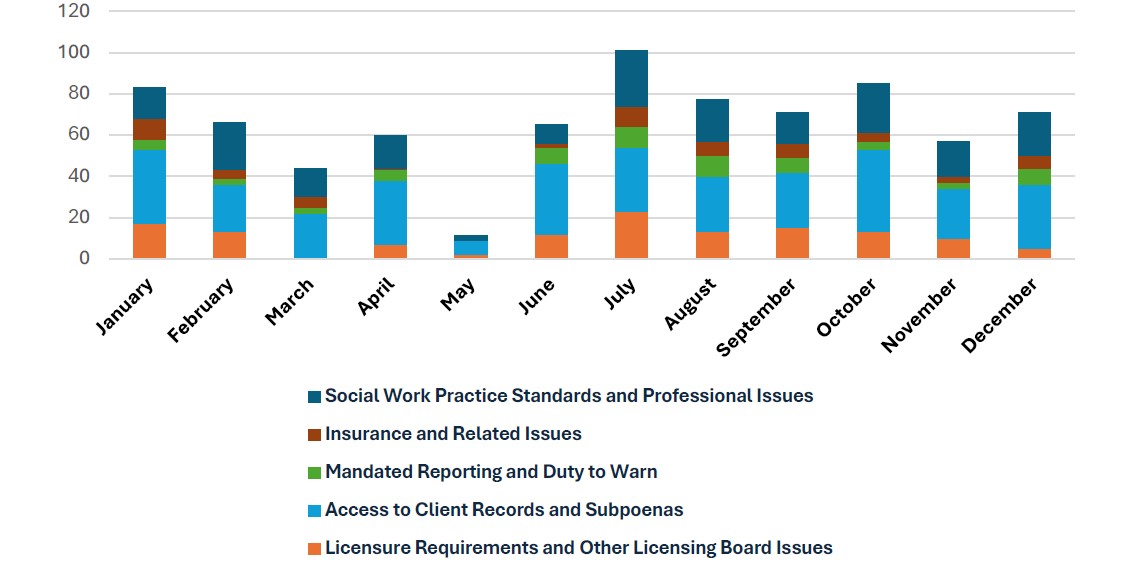
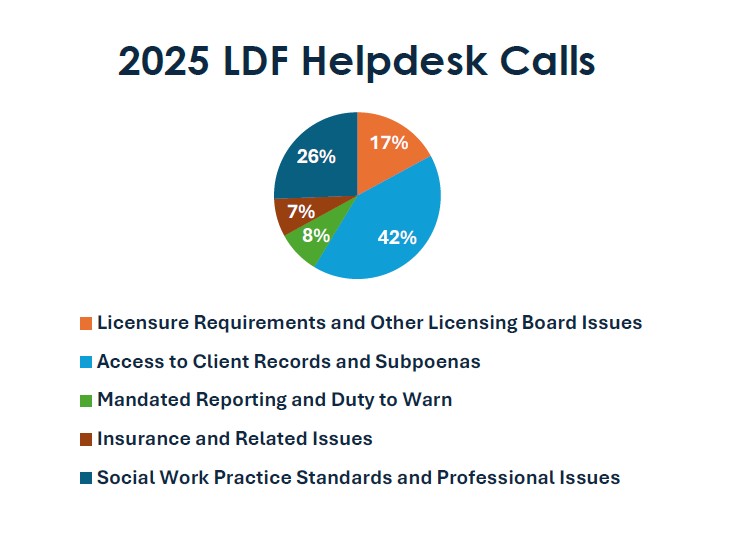
Our members turned to NASW's Legal Defense Fund with critical questions this year. Here's the top
three categories:
-
Access to Client Records & Subpoenas (333 calls)
The most common challenge: navigating third-party requests for client information. Social workers
needed guidance on responding to subpoenas, handling insurance agency demands, managing
custody disputes involving minor records, and understanding record retention requirements.
- Social Work Practice Standards & Professional Issues (205 calls)
From launching a new practice to ethically closing one, social workers sought clarity on the business
and professional aspects of their work—including how to find legal representation and appropriately
terminate client relationships.
- Licensure Requirements and other Licensing Board Issues (137 calls)
Regulatory compliance questions dominated this category, particularly around licensing board
complaints, providing telehealth services across state lines, and meeting supervision requirements
for licensure.
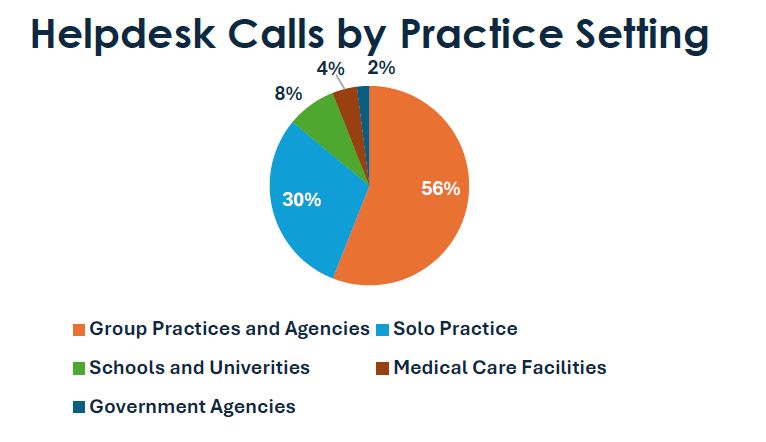
The LDF Helpdesk received calls from members who work in many different settings, including group
practices or agencies (56%), solo practice (30%), schools and universities (8%), medical care
Facilities (4%), and those with government positions (2%).
2025 Member Education Programs
LDF designed and delivered professional education programs for NASW members nationwide, many
offering Continuing Education credits. These programs addressed emerging practice issues identified
through LDF's member consultation services. Our past programs can be found on our
website and can
be accessed on demand.
Presenters: Allison Puryear, Ashlee Fox
This presentation addressed a long-standing need among social workers who are navigating private
practice without adequate legal or business preparation. The session focused on documentation,
confidentiality, contract management, marketing, and insurance considerations, providing clear,
accessible guidance that practitioners could immediately apply.
2025 NASW Conference: Is it Ethical? Is it Legal? Contemporary Dilemmas in Social Work
Practice
(June 2025)
Presenters: Ashlee Fox, Andrea Murray
Ethics and legal calls are among the most valued benefits offered to NASW members. Each year, the
Association interfaces with thousands of social workers around ethics and legal questions. The data
garnered from NASW legal and ethics consultations uniquely postures the association to articulate
key ethical and legal challenges facing the social work profession. This symposium examined the
leading ethical and legal concerns facing the profession; identified trends; and equipped participants
with best practice guidance and strategies that will advance ethical and legal practice. The
presentation addressed micro, mezzo, and macro perspectives regarding current dilemmas and
challenges facing social workers and allied health professionals.
Presenters: Ashlee Fox, Dr. Karen Goodenough (Executive Director-Minnesota), and Dante Lentz
Responding directly to member inquiries through the LDF Helpdesk, this program clarified the ethical
and legal parameters of coaching services for licensed social workers. Co-presentation with Dr. Karen
Goodenough, Minnesota Executive Director underscored the strategic importance of this emerging
practice issue and the Social Work Licensure Compact.
LDF Grants
One of the primary ways the Legal Defense Fund (LDF) advances the legal interests of the social work
profession is through its LDF Grant program. LDF Grants provide financial assistance to help defray
legal expenses incurred by NASW members engaged in litigation that implicates the NASW
Code of
Ethics
, social work principles, or standards of social work practice advocated by the Association.
When reviewing LDF Grant applications, several factors are considered, including:
- Whether the applicant is an active member of NASW;
- Whether the issues presented in the application are significant to the social work profession;
- Whether the legal matter/lawsuit involves the NASW Code of Ethics or principles and
standards of social work practice advocated by NASW;
The LDF Board of Trustees reviews all properly completed applications at each LDF Board Meeting.
Legal issues that may warrant consideration for an LDF Grant include pay equity, client confidentiality,
restrictions or prohibitions on the right of social workers to join professional organizations, and
regulatory restrictions that improperly limit social work practice. Most recently, LDF provided financial
assistance to an NASW member involved in a legal dispute related to an insurance clawback.
More information about the LDF Grant process and the LDF Grant application can be found
here.
Member Publications & Alerts
LDF authored timely legal updates for NASW members on rapidly evolving regulatory matters:
Author: Tyra Robinson
As litigation challenged this new federal reporting requirement, LDF published multiple updates
keeping private practice social workers informed of their obligations. When businesses were
ultimately exempted, these alerts saved members from unnecessary compliance costs and
confusion.
Authors: Ashlee Fox and Catera Pettway
In light of a January 2025 executive order removing protections that previously kept ICE out of schools,
hospitals, and other sensitive location, LDF published this article providing critical guidance for social
workers navigating this new landscape. What are social workers’ legal obligations and available
options when faced with immigration enforcement actions? How do they balance client protections
like confidentiality with professional duties?
Authors: Ashlee Fox and Catera Pettway
The article alerted and educated NASW members about the March 2025 executive order affecting the
Public Service Loan Forgiveness (PSLF) program and its potential consequences for social workers.
The order directed the Department of Education to redefine “public service” in ways that could exclude
certain nonprofits—particularly those involved in immigration, DEI, protest activity, or gender-affirming
care—based on broadly worded criteria. Although the changes had not yet taken effect, the
proposal raised significant concerns for social workers and other nonprofit employees who rely on
PSLF, underscoring the importance of borrowers verifying their eligibility and documentation.
Authors: Updated by Catera Pettway
Telehealth has expanded access to clinical social work services, but it remains tightly regulated by
federal and state law. This article emphasizes that most pandemic-era flexibilities have expired,
meaning social workers must once again ensure they are licensed where the client is located, use
HIPAA-compliant technology, and obtain appropriate informed consent. The article also highlights
high risk areas—including privacy, cross-jurisdiction practice, and insurance coverage—and provides
best practices to help clinical social workers deliver telehealth services ethically, securely, and in
compliance with evolving legal requirements.
Authors: Ashlee Fox and Catera Pettway
When disasters strike, the demand for social workers surges, and so do legal and ethical complexities.
This article provided essential guidance for social workers responding to disasters: how emergency
licensure waivers work (and why they vary by state), what the Social Work Licensure Compact means
for disaster response, permissible disclosure of protected health information without consent
pursuant to HIPAA, and how to navigate ethical dilemmas around self-determination, competence,
and dual relationships in high-stress environments.
Authors: Ashlee Fox and Catera Pettway
In response to a January 2025 executive order directing federal agencies to withdraw funding and
support for gender affirming care for minors, LDF published this article identifying important
information for social workers: shifting federal policies affecting client protections, legal mental health
services in restrictive states, protecting client confidentiality, navigating cross-state referrals, and
more.
Author: Dante Lentz
Social workers have traded file boxes for flash drives, and with that shift comes serious cybersecurity
responsibilities. Electronic protected health information (ePHI) is vulnerable to malware, phishing
attacks, and data breaches, and social workers must be prepared to respond appropriately when
breaches occur. This article explains what constitutes a privacy breach under HIPAA and the HITECH
Act, outlines prevention strategies (encryption, multifactor authentication, robust backup systems),
and provides step-by-step guidance on responding to breaches, including notification requirements,
timelines, and reporting obligations to clients, government agencies, and potentially the media.
Author: Dante Lentz
Most social workers know their child abuse reporting obligations, but elder abuse remains less familiar
territory despite affecting nearly one in twenty older adults annually, and that's just what's selfreported.
Elder abuse takes many forms: physical harm, sexual abuse, neglect, financial exploitation,
emotional abuse, abandonment, and even self-neglect. This article clarifies what constitutes elder
abuse under new federal standards, identifies six types of abuse and their warning signs, explains the
role of Adult Protective Services and Long-Term Care Ombudsmen, and outlines mandatory reporting
requirements, which vary by state but typically require social workers to report suspicions, not proof.
Author: Dante Lentz
As coaching continues to grow in popularity, many social workers are integrating coaching techniques
into their practice or considering separate coaching businesses. Because coaching is largely
unregulated, these practices create legal and licensure questions. This article explores the key
differences between social work and coaching, the legal considerations for social workers who coach,
emerging state regulations in the field, and what social workers should understand before
incorporating coaching into their work, either within their existing practice or as a separate venture.
Conclusion
Over the past year, LDF has provided legal guidance to NASW members by responding to over 800
member calls and offering valuable legal resources in response to calls pertaining to client records,
subpoenas, telehealth, client confidentiality, and licensing. LDF continues its role in educating
members about social workers’ legal rights and ethical responsibilities through webinars, online
resources, and availability of published legal articles.
The need for legal information and resources among NASW members remains high and the Legal
Defense Fund is well-positioned to serve members by maintaining and expanding communication
with members, all social workers, and the public.
The following NASW members currently serve on the LDF Board of Trustees:
Chair
Reinaldo “Ray” Cardona, MSSW, LCSW-R
(2023-2026) (2nd term)
Adjunct Instructor
University at Albany
Vice Chair
Dr. Quincy L. Dinnerson, DSW, LMSW, QMHP-C, ACSW
(2025-2028) (2nd term)
Assistant Professor/BSW Director of Field Ed,
The Ethelyn R. Strong School of Social Work
Dr. Shanika Lavi Wilson, DSW, LCAS, LCSW
(2023-2026) (1st term)
Associate Professor
Department of Social Work
North Carolina Central University
Dr. Herman Curiel
(2025-2028) (2nd term)
Retired Professor Emeritus
University of Oklahoma
Bisrat Abebe (National Board Rep)
(2025–2026) (1st term)
Carmeann Foster, JD, LICSW
(2023 – 2026) (2nd term)
Frances Schopick, JD, MSW
(2024 – 2027) (2nd term)
Assigned Staff:
Cheryl-Lyn Bentley-Harmon, JD, MSEd
General Counsel
Ashlee Fox, JD, MSW
Deputy General Counsel
Dante Lentz
Paralegal