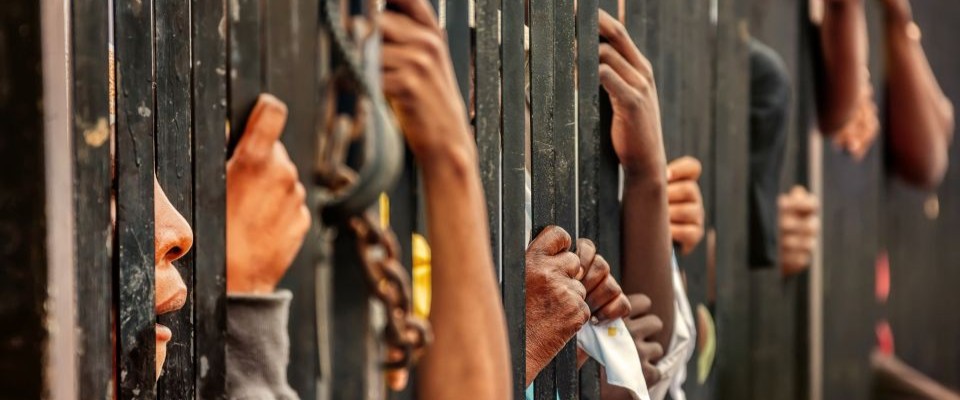
Emerging Immigrant Detention Crisis
Mel Wilson, LCSW, MBA
Senior Policy Advisor
After over a year of the Trump administration’s implemented Mass Deportation policy, we have been painfully made aware of the human implications of the policy—principally when it comes to ICE detention. Overall, the path of the Trump administration’s Mass Deportation policy has taken has been disturbing—on many fronts—since its inception in January of 2025. This has led to many Americans being appalled by the dangerous aggression and disregard for Constitutionally protected due process by ICE agents in their mass deportation operations.
Compounding an already problematic effect of ICE raids and arrests is an emerging human rights and child welfare crisis related to ICE detention facilities—particularly for families and unaccompanied migrant children. This emerging crisis is driven and exacerbated primarily by the administration’s plan to deport as many as 1 million immigrants in a year. An effort of that magnitude dictates that the DHS will struggle to ensure they have sufficient “bed” capacity to meet that daunting need. It also means that ICE must rapidly hire and train staff with varying levels of expertise and credentials to operate such detention facilities—not to mention meeting safety and health standards for adults and children.
Background
In order to achieve such an ambitious goal, DHS is in the process of expanding its current detention capacity by 92,000 detention beds—for single adults and families—nationwide. The current DHS/ICE plan is for 8 mega-warehouse centers with each center capable of holding up to 10,000 detainees. Estimates are that the cost for the expansion will have a total price tag of $38.4 billion.
Furthermore, the current and future impact on detainees that the DHS strategy is causing is—not surprisingly—alarming and showing signs of impending human rights violations.
This is a multi-layered concern that begins with the White House’s unwavering unjustifiable insistence its national mandate is to remove undocumented non-citizens regardless of due process and human rights considerations. Further concerns include the administrative and logistical challenges of expanding ICE detention capacity. For example—using existing DHS targets of expanding to 92,000 new “beds”—it is impossible to achieve that target through “bricks and mortar” constructions.
Secondly, the immigrant rights community is very skeptical DHS/ICE has the capacity or—more to the point—the commitment—to offer and provide the necessary health, behavioral health, child welfare, social services, and legal supports for 96,000 people. Absent those services and supports, the likelihood of human rights abuses will skyrocket.
Given the gravity of this emerging crisis, it is essential that we fully discuss the implication from the perspective of impacted—and at-risk for being impacted—individuals and families. The following is a comprehensive analysis of the historical context, current situation, and mitigating actions being taken by the immigration, civil rights, and social justice communities.
Public Outcry to the Warehouse Conversion Model for Detention Facilities
As alluded to earlier, The Department of Homeland Security’s (DHS) plan—developed under the ICE Detention Reengineering Initiative—is projected to expand total detention capacity to 92,600 beds by late 2026 through a network of warehouse-converted facilities. As of early April 2026, progress is significant but incomplete.
Significantly, the program is facing delays, legal challenges, and internal review that may hinder meeting the expansion objectives.
Thus far:
- At least 11 warehouses have already been purchased across multiple states including Arizona, Georgia, Maryland, Michigan, New Jersey, Pennsylvania, Texas, and Utah—totaling $1.074 billion in spending.
- Eventually these acquisitions will result in: (1) 16 regional processing centers (1,000–1,500 detainees each, 3–7-day stays); (2) 8 large-scale detention centers (7,000–10,000 detainees each, <60-day stays) and 10 existing facilities to be incorporated into the system.
DHS has made significant progress in acquiring warehouse properties; However, they face both challenges with physically converting the warehouses into fully operationalized detention centers—as well as overcoming community-driven opposition. This means that the DHS is far behind meeting its projected conversion targets by the end of 2026.
Perhaps the most problematic aspect—for the Trump administration—of the DHS plan to convert warehouses is that the public response which has been overwhelmingly negative. A significant part of the public reaction centered on moral objections to detaining human beings in converted industrial warehouses. For example, there are those who compare the concept to historical atrocities—such as the World War II era concentration camps. Civil rights groups point to dehumanization concerns and conditions that conjure up images of warehousing merchandize as opposed to human beings—likening conditions to treating migrants like “Amazon Prime inventory.”
Adverse Detention Conditions
Beyond the moral objections to “warehousing” migrants, there are widespread accusations and conjecture about the quality of support services—related to health/behavioral health, safety, human rights, environmental risks—associated with expedited conversion of warehouses to secured detention centers.
Within the human-rights, immigrant-rights, and health-rights communities, there is a consistent and urgent alert: ICE detention centers are failing to provide adequate medical, mental/behavioral health, and child/family services, and conditions are worsening under mass-deportation policies.
That contention is reinforced by the fact that the Trump administration has reduced oversight of operations in immigration detention facilities, which will add to adverse conditions and health risks in detention centers, including for children and families in detention. The administration has shut down watchdog agencies in DHS, including the Immigration Detention Ombudsman.
That DHS eliminated its ICE detention ombudsman is unfortunate. Had that position been in place, the incumbent would likely become aware of—and report on the accusations that recently detained migrants are faced poor and sometimes dangerous conditions. For example, migrants are not only held in newly converted warehouse, but are also detained in holding facilities such as local jails and field offices—not designed for long-term detention—while they are processed. Furthermore, this group of migrants may not be included in ICE detention statistics. An analysis of ICE detention overall found that many detention facilities exceeded contractual capacity, All of which leads to overcrowding conditions—especially if deportations do not keep up with the pace of arrests.
Relatedly, ICE inspectors found that migrants held in an unfinished Texas facility still under construction violated many detention standards and failed to properly treat medical conditions. Other recent reports have also detailed how migrants in detention:
A particular statistic that deserves special attention is the fact that, as of September 2025, 15 immigrants have died in detention. This number is compared to 8 deaths in all of 2024 and the most seen under ICE custody since 2020.
Specific to the converted warehouse detention model, there are those who attribute poor planning and unacceptable conditions to DHS’ lack of transparency about the size and scope of these warehouse retrofitting projects. Communities across the United States—including Maryland, Missouri, New Hampshire, and Oklahoma—have protested, filed lawsuits, and pressured property owners not to sell to ICE.
Family and Child Detention
In March 2025, the federal government re opened and re-instituted family detention centers or “family residential centers” (FRCs) managed by ICE and operated by private prison corporations, where children are detained, often with their mothers and separated from their fathers who might also be at the facilities. Since then, the number of families in detention centers has more than tripled, detaining children of all ages, starting in infancy. The amount of time children spend in these detention centers has more than doubled. Research shows that both direct detention and the constant threat of family separation contribute high levels of stress, disrupt healthy development, and expose millions of children in immigrant families to long-term trauma. The dramatic expansion of family detention centers raised alarms and intensified long-standing concerns about the safety, well-being, and rights of migrant families.
Correspondingly, ICE’s over emphasis on enforcement, detention, and deportation (in that order) resulted in a de-emphasis of a child-welfare approach to housing groups of children—as was the model when the Office of Refugee Resettlement (ORR) was the dominant agency for migrant children. Under the ORR standard, families and children were “placed” in centers until either their immigration hearing was held or when an unaccompanied migrant child was placed with a relative or in foster care. In the interim, the children were provided with appropriate child protections, health/behavioral health services, and family support services. Concerns for the impact of
detained parents on their children should not
be minimized.
New research from the Brookings
Institution
on the characteristics of children
impacted by the increase in deportation and
detention estimates that more than 100,000
U.S. citizen children have had a parent
detained, and approximately 22,000 citizen
children have been left without a parent in the
home due to detention
With the shift to a mass deportation mindset, family and child facilities are “detention” centers in the truest meaning of the word—meaning that the facilities are secured and the detainees’ movements are severely restricted. The current ICE family and child centers only offer a bare minimum of child-welfare services. For those reasons, there is a growing and deeply troubling pattern in which the welfare of children—particularly unaccompanied migrant children and children in mixed-status families who are American citizen—is in jeopardy.
Family and Child Detention Center in Dilley, Texas
The South Texas Family Residential Center in Dilley, Texas. a.k.a. Dilley has become a lightning rod as a prototype of an ill-managed, woefully under-resourced, ICE family detention center. Conditions at Dilley are such that there is a national mobilization call for closure of the facility. Recent court filings and attorney reports describe nearly 600 migrant children held at the Dilley facility in recent months, many far beyond the 2 day legal limit established under the Flores settlement. Some of the questionable conditions reported include:
- Insufficient food and cloudy or unsafe drinking water
- Inadequate medical care and delayed treatment
- Lack of mental health services, even for children in crisis
- Virus outbreaks and extended lockdowns inside the facility
Immigrant rights, child protection, and human rights organizations emphasize that closing Dilley is only the first step. Collectively, they call for:
These claims against DHS and the private contractor who manages the facility on a day-to-day basis appear in court filings. Federal officials and CoreCivic (the private operator) have denied or disputed many of these allegations, but their denials have not eased public outcries.
Adult Facility: Camp East Montana
Similar to the troubling circumstance at Dilley, a second Texas ICE facility—Camp East Montana (an adult center)—is the subject of reports of physical abuse of detainee, among other human rights violations. Because the detention center is in his district, Texas Congressman Gabe Vasquez recently visited as a follow-up to an internal ICE report that identified over four dozen incidents in which the agency violated national standards for detainees. Camp East Montana—a collection of massive tents where immigrants are being housed—is the largest facility being operated by ICE. In a tacit admission of civil rights violations at Camp East Montana, ICE replaced the lead contractor operating the detention center.
To quote Congressman Vasquez, “The conditions that I saw inside the detention facility today are beneath our American values. We heard concerns regarding withholding of medical care. They said you practically have to be down on the ground, dying, choking before you receive medical care.” The new report, via ICE’s Office of Professional Responsibility, cites violations related to:
- Use of force and restraints, where guards failed to document use of force against detainees as well failing to preserve evidence.
- Examples of violations involving medical care, including officials failing to adequately quarantine or test people who showed signs of tuberculosis and failing to test some detainees for HIV; and
- The report also found the facility “has not implemented a coordinated, multidisciplinary team approach to responding to sexual abuse and assault.”
Immigrant rights and human rights activists have been raising concerns about conditions at Camp East Montana many months. For example, National Public Radio (NPR) reports recent suspicious deaths occurring at the center. Among three confirmed deaths is that of a 55-year-old Cuban immigrant, whose death the medical examiner ruled a homicide by asphyxia after federal officials claimed it was a suicide attempt.
Restricted Access to Release on Bond
Since implementing the Trump administration’s mass deportation program, bond has become extremely restricted or effectively unavailable for many people arrested on immigration violations. This is due to mass deportation policy changes that emphasize mandatory detention and sharply limit discretionary release.
Bail denial in immigration cases is widely described by non-governmental organizations as an unfair and deeply harmful practice because it often keeps people in detention without meaningful individualized review, restricts due-process protections, and imposes severe personal, legal, and economic consequences on individuals navigating a civil—not criminal—system. Research and reporting highlight how inconsistent standards, limited access to counsel, and structural barriers lead to prolonged detention, family separation, and significantly worse legal outcomes for those denied release. On the rare occasion when a detained migrant is permitted to apply for release on bond, their families are having to struggle to come up with enormous sums to secure their freedom—far higher than what was typical in prior years.
The bottom line for denial of bail is that unauthorized migrant parents are detained for longer—often indefinitely. As a reminder, ICE policies that restrict or eliminate bond mean that adults—especially those who entered without authorization—are not allowed to ask for release, regardless whether or not they pose danger or flight risk.
When adults cannot be released, families are separated because children cannot legally be held in ICE detention long-term.
Due Process Concerns in ICE Detention
The most impactful area of concern that intersects with mass deportation ICE detention policies and processes is that of due process. Using multiple sources, the most persistent due process issues in ICE detention involve:
(1) lack of timely access to courts and bond hearings, (2) obstacles to securing legal representation, (3) prolonged or arbitrary detention, (4) Inconsistent or ineffective oversight, and (5) government noncompliance with judicial orders. These problems affect asylum seekers, long-term U.S. residents, and even U.S. citizens, raising significant constitutional and statutory concerns.
For obvious reasons, denial of due process should not be taken lightly. Yet, the Trump administration has been steadfast about the use of expedited removals, aggressive detention practices, and rapid-processing enforcement strategies—all of which ignore or circumvent due process protections.
Major Private Contractors that Run ICE Detention Centers
Privatization of day-to-day management of ICE detention facilities is not new. The Obama and Biden administrations extensively contracted with private prison corporations to run such facilities. However, in anticipation of mass deportation spending needs Congress included an unprecedented $45 billion for ICE to build new immigration detention centers that will house both adults and children. As of Sept. 7, there were 58,766 people in ICE detention, compared with the 37,395 being held at the same time last year. This budget expansion all but guaranteed a boon to the private prison industry. This arrangement has come under criticism from the immigrant rights community.
Those in opposition to privatization see major drawbacks of relying on private-sector contractors to manage ICE detention facilities because of the profit-driven structure of these contracts. They argue that such contracts potentially create powerful incentives to cut costs at the expense of detainee safety, humane conditions, and meaningful oversight. Investigations by government watchdogs and advocacy organizations have documented how private prison companies benefit from guaranteed minimum payments, no-bid contracts, and long-term agreements that reduce accountability while encouraging the expansion of detention capacity. This system has been linked to patterns of inadequate medical care, poor living conditions, and even preventable deaths with reports showing that weak oversight and financial incentives often override detainee welfare.
Main Private Prison Contractors
Because of the billions of dollars in revenues that private prison corporations stand to gain from DHS/ICE contracts, it is important to discuss the main contractors—as well as their roles. The following is a list of corporations that own/operate ICE detention facilities under contract with DHS/ICE
Role: One of the largest private prison/detention companies; operates multiple ICE detention centers (e.g., Otay Mesa, Stewart, Eloy, etc.).
Funding: Public SEC filings show hundreds of millions per year in revenue from federal immigration contracts (ICE and U.S. Marshals). ICE-related revenue has typically been in the $400–600 million/year range, depending on bed usage and contract renewals.
Role: Major private operator of ICE detention centers (e.g., Adelanto, Aurora, Karnes, etc.).
Funding: Like CoreCivic, GEO’s public filings show hundreds of millions per year from federal immigration contracts. ICE-related revenue has generally been in the $400–600 million/year range in recent years, again depending on occupancy and contract structure.
Role: Private corrections company that has operated several ICE facilities (e.g., Otero County Processing Center under partnership, others over time).
Funding: MTC is privately held, so it does not publish detailed ICE revenue. Available contract awards and watchdog reports suggest tens to low hundreds of millions per year in ICE-related contracts, but not a precise public total.
Role: Regional private corrections company that has operated multiple ICE detention centers in the South including Winn Correctional Center. LaSalle ICE Processing Center (Jena, Louisiana) and South Louisiana (Basile, Louisiana).
Funding: Also privately held; ICE contract values indicate tens of millions per year in detention revenue, varying by facility and year.
Questions about quality of services and casual commitments to due process in the privatized ICE detention system are warranted. However, equally concerning is the apparent “cozy” political relationship between main private prison contractors and the Trump administration. For instance,
- Executives and PACs from GEO Group and CoreCivic—the two biggest ICE contractors—have donated millions of dollars to candidates, parties, and PACs, closely affiliated with Republican and Trump-aligned groups.
- The GEO Group and its subsidiaries gave over $1 million to super PACs supporting Trump’s reelection, including Make America Great Again Inc.
- Private prison industry lobbying spending peaked during Trump’s first term and remained high in his return to office—these companies received over a billion dollars in detention-related contracts in just a few years.
Specific benefits to the private-prison industry of its close ties with the Trump administration include (1) The Trump administration reversed an Obama era decision to greatly cutback on contract to private prisons—under Trump, and ICE detention contracts with private companies expanded instead of shrinking and; (2) The Trump administration’s mass deportation policy (and later congressional funding increases led to tens of thousands of new detention beds). The GEO Group publicly stated that new ICE contracts worth tens of billions of dollars represented—an “unprecedented opportunity,”.
Summary
In summary, the discussion covered in this brief emphasizes how the expansion of migrant detention—including family and child detention—during the Trump administration’s mass-deportation policy raises significant concerns among legal experts, human rights organizations, and the immigration rights communities. They have expressed worries that overcrowded facilities, inconsistent access to medical and related care, and failures to adhere to established federal standards will result in civil and human rights violations in an already precarious environment. Indeed, the explosive situation in the Dilley, Texas family detention center suggests advocate’s apprehensions have come to fruition.
It is also important to restate that the rapid expansion of detention facilities directly intersects with an equally aggressive expansion of ICE enforcement agents—who were deployed throughout non-border states in the U.S. The mandate of ICE agents is to maximize arrests and detention of suspected unauthorized non-citizens—with the intent to expeditiously remove them from the U.S.
In order to meet its deportation goals, not only does DHS have to greatly increase detention beds, but it must also do so very quickly. Moreover, in order to accommodate as many as 1 million new detainees a year, deportation of already incarcerated detainees must occur frequently—thereby continually freeing up detention beds for new arrivals.
The truth is that the process described above cannot succeed without ceding decision-making power to ICE, allowing it situational authority to shift detention-related operational tactics. In practice, the ceded power has led to ICE questionably reimagining operations policies in such a way as to implement plans with limited hierarchical oversight. The result of the autonomy afforded ICE includes the overuse of highly restrictive policies along with ICE’s penchant for operating “above the law” andemploying extrajudicial tactics. Key among dubious ICE “tools” for circumventing standards include (1) Mandatory Expeditated Removals; (2) Mandatory Detention; (3) Ignoring migrant’s right to seek asylum; (4) Right to legal representation; and (5) Right to a Bond Hearing Before a Neutral Judge.
There is clearly a symbiotic relationship between mass deportation policies and its component parts of enforcement and detention. What is also unambiguous is that the Trump administration’s mass deportation agenda comes with serious and direct consequences to 11-15 million people—including close to 5 million children.
Furthermore, what has been discussed here points to a complex emerging bio-psychosocial crisis that will impact millions of adults but also have significant long-term child-welfare complications.
There is an urgency for immigrant rights and social justice/human rights activists to join hands with government and non-governmental allies to respond to the migrant detention crisis. There is a growing national consensus that the Trump administration is treating immigration as a political weapon aimed at punishing unauthorized non-citizens—especially those of color—as opposed to facilitating a path to citizenship.
Such a forward-looking policy discussion will require not only evaluating the impacts of the current migrant detention but also center on protecting the dignity and well-being of the individuals affected. One step in that direction is to collectively get back on track with bipartisan immigration reform legislation.
Resources
American Civil Liberties Union (ACLU)
New Class-Action Lawsuit Challenges Widespread Denial of Due Process in Immigration Courts
Appleseed's Family Preparedness Guide
Appleseed
Network Deportation Preparation Manual for Immigrant Families – Make a
Plan to Protect Your Kids and Finances in the Face of Deportation
Brennan Center for Justice
How ICE’s Budget Boom Is Changing Immigration Detention.
Brennan Center for Justice
The Detention of Families Facing Deportation Proceedings.
Brooking Institute
What will deportations mean for the child welfare system?
Center for Law and Social Policy (CLASP)
Know Your Rights: Five Things Parents Detained by ICE Should Know | CLASP
Center for Law and Social Policy (CLASP)
Still at Risk: The Urgent Need to Address Immigration Enforcement's Harms to Children | CLASP
Children Defense Fund-
Free Families campaign from the National Coalition to End Family and Child Detention.
Children Thrive Action Network
Love Letter to Immigrant Parents
Georgetown University
Explainer
for Parents and Their Helpers Seeking Family Reunification
News from the States
Amid national surge in constitutional challenges to ICE detention, Mississippi cases remain undecided.
The Global Switchboard
America’s Broken Promises: ICE Detention and the U.S. Violation of International Human Rights Law.
ProPublica
ICE Has Placed a Record 600 Immigrant Kids in Federal Shelters This Year.
NASW Resources
NASW » SocialWorkers.org
NASW Foundation » NASWFoundation.org
NASW Press » NASWPress.org
NASW Assurance Services, Inc. » NASWAssurance.org
Find A Social Worker » HelpStartsHere.org
Social Work Blog » SocialWorkBlog.org
NASW Research and Data » SocialWorkers.org/News
Social Work Advocacy » SocialWorkers.org/Advocacy